The Onchain Financial Stack
WeFi combines blockchain infrastructure, distributed custody, and algorithmic economics to create a complete financial services platform. Every component is designed for transparency, security, and regulatory compliance.
WeChain: Purpose-Built for Finance
Unlike general-purpose blockchains, WeChain is specifically designed for banking and financial services. Native compliance hooks, high-performance settlement, and seamless fiat integration come standard.
WeChain Architecture
The Deobank Model
A Deobank is a regulated financial service provider that uses blockchain as its core accounting and settlement layer. Unlike neobanks that operate as cosmetic layers on legacy databases, Deobanks provide transparent, efficient, user-sovereign banking.
Compliance Built-In
Programmable KYC/AML at the protocol level. Regulatory requirements encoded in smart contracts.
Instant Settlement
Sub-second finality for all transactions. No more waiting for ACH or wire transfers.
User Sovereignty
Users maintain ultimate control of assets. MPC wallets ensure no single point of failure.
Traditional vs. Onchain Accounting
The Trust Machine
Every transaction in the WeFi ecosystem is recorded on a public, immutable ledger. This is not just a technical choice—it's a fundamental reimagining of banking transparency.
- Immutable records that cannot be altered
- Real-time verification by anyone
- Mathematical certainty over trust
Distributed Custody (MPC)
Multi-Party Computation enables user sovereignty without sacrificing UX. Assets are protected by distributed key shares—no single point of failure.
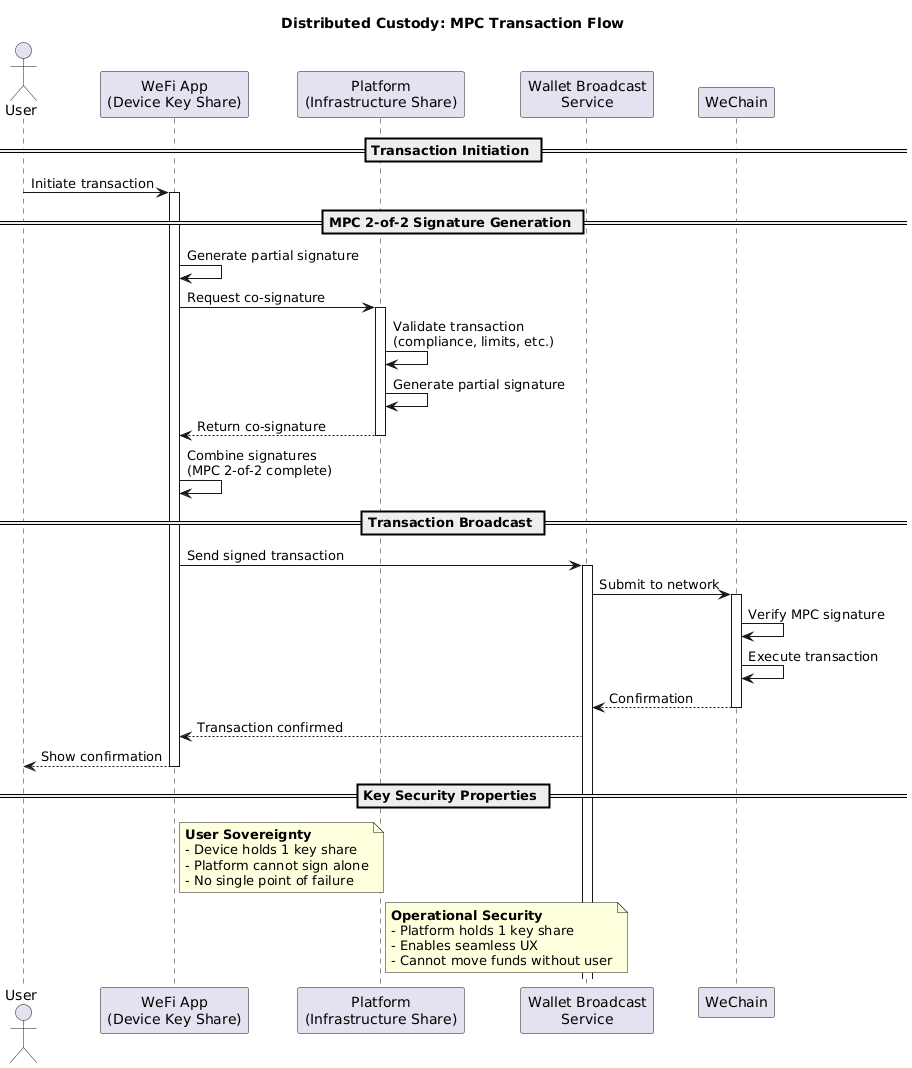
2-of-2 MPC signature flow: Device key share + Platform infrastructure share
User Sovereignty
Device holds 1 key share. Platform cannot sign transactions without user authorization.
No Single Point of Failure
Distributed architecture eliminates centralized key storage risks.
Seamless UX
Platform holds 1 share for operational efficiency while maintaining security.
Algorithmic Tokenomics
The stability and growth of the $WFI asset are governed by four automated, algorithmic rules. These rules ensure that the token economy remains stable, resilient, and perfectly aligned with real-world product adoption.
Systematic Halving
Reduces mining rewards by 50% every 2 years. Years 1-2: 8 tokens/sec → Years 7-8: 1 token/sec. Creates progressive scarcity.
Mathematical Supply Control
Supply released in 100M token blocks. Only unlocked when Energy levels indicate ecosystem maturity. Prevents market flooding.
Algorithmic Amortization
Older mining units gradually decrease efficiency. Prevents early whale dominance. Ensures competitive environment for new participants.
Energy Proxy Unit
Measures real product adoption. Gates new supply based on proven utility. Creates demand-driven tokenomics.
Token Supply Breakdown
Cloud-Based Mining & Vesting Workflow
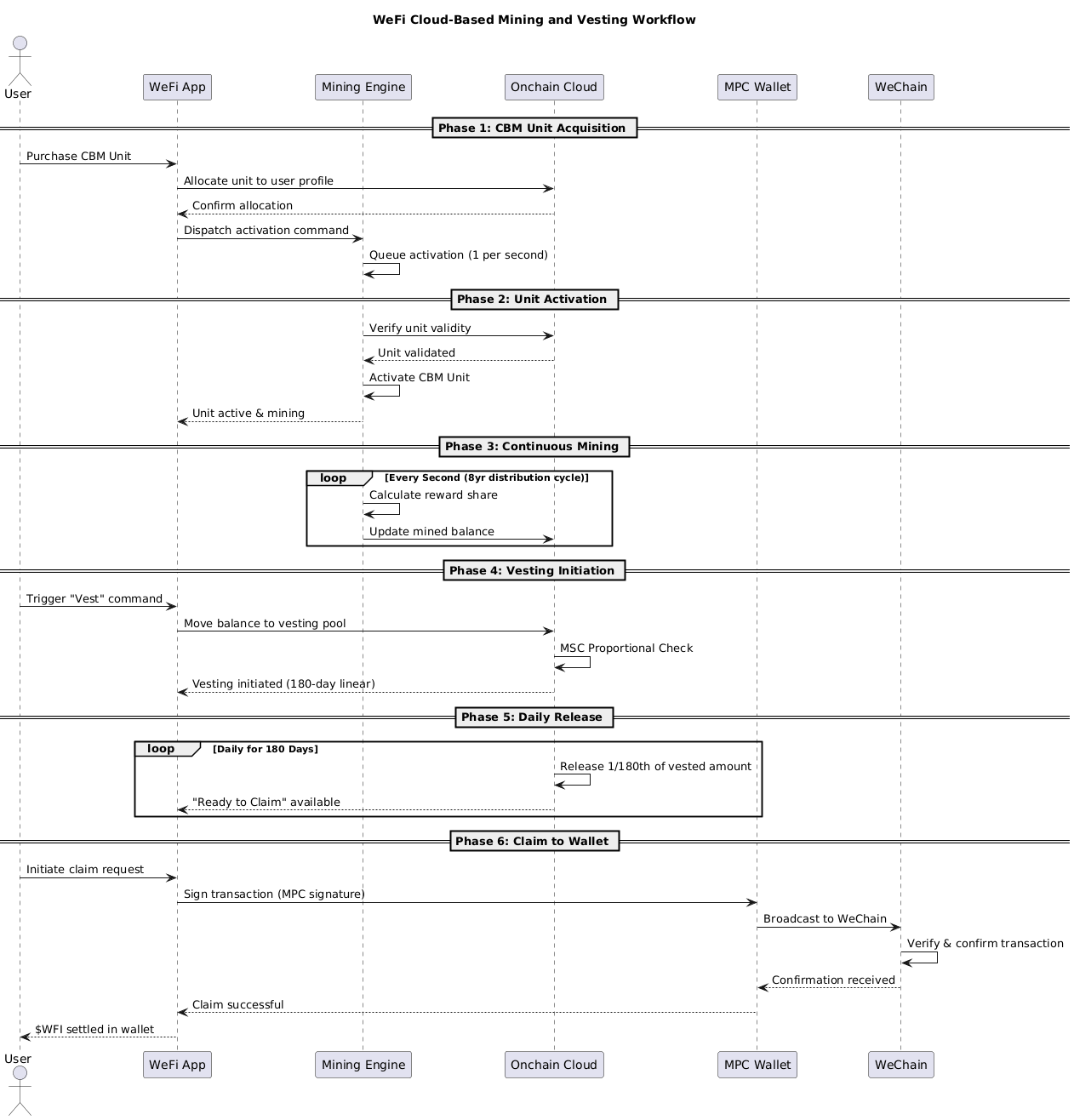
Complete flow from CBM Unit purchase through continuous mining to vesting and claiming
Want to dive deeper?
Explore our comprehensive documentation to understand the full technical architecture.
Explore Platform